A 36-sensor pressure array
This tactile touchpad module features a high-density array of 36 MEMS barometric pressure sensors within a compact 50 × 65 mm form factor, enabling high-resolution tactile sensing. Although designed primarily as a tactile touchpad, the platform has potential applications in robotics, advanced human-machine interfaces, haptic research and other pressure-sensing systems.
The primary objective is to investigate the performance characteristics of dense pressure-sensor arrays: achievable sampling frequency, spatial resolution, sensitivity, noise behaviour and potential hysteresis effects. The study also explores other factors that influence measurement accuracy, responsiveness and overall performance in high-density tactile sensing.
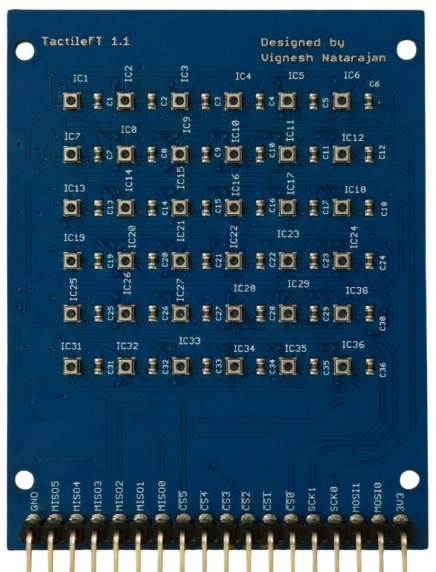
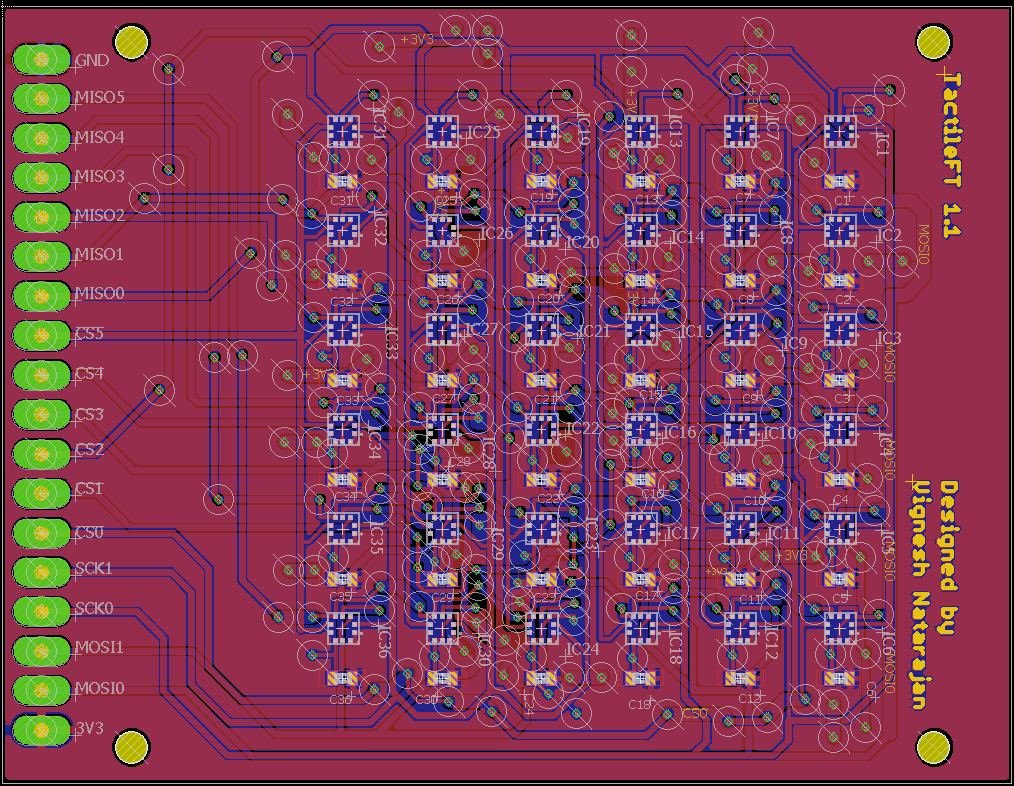
Controller board
A dedicated controller board interfaces with the sensor array and handles data acquisition. It is responsible for sensor communication, data collection and transfer to a host system for processing and analysis. The complete controller design, including schematics, PCB layout files, firmware and documentation, is open source on GitHub.
Status
At present only the basic functionality of the module has been validated, as development was paused for other commitments. The communication protocol, firmware enhancements and the silicone surface molding for the final touchpad interface are still under development. Schematics, evaluation results and further details will be shared once testing and evaluation are complete.
Possible applications
Robotics, haptic feedback systems, gaming interfaces, smart input devices, gesture-recognition systems and other applications that need high-resolution tactile sensing.